
Last year, a client from Vietnam sent me photos of his new pellet line. He had bought a horizontal ring die pellet mill to process rice husks — and within three months, his die was worn unevenly, his fines rate was over 15%, and his electricity bill was hurting. The machine wasn’t “bad.” It was simply the wrong design for his raw material.
That project is why I wrote this guide. Over the past eight years at Huaxin Machinery, I have visited more than 40 wood pellet plant sites across Southeast Asia, Africa, and Europe, and tested both vertical and horizontal ring die pellet mill designs with sawdust, straw, rice husks, peanut shells, and hardwood chips. If you’re researching how to choose a pellet mill for a biomass pellet production line, this article will save you from expensive mistakes.
Quick Answer First
For most biomass fuel producers — especially those using light, low-density materials like sawdust, straw, rice husks, and peanut shells — the vertical ring die pellet mill is the better choice. It feeds by gravity, forms pellets more evenly, and costs less to maintain.
For very large industrial pellet mill lines (5+ tons/hour) running uniform feedstock 24/7, or for feed pellet mill production, the horizontal design still has advantages in proven gearbox technology and higher single-line capacity.
Now let me explain why.
1. How the Two Wood Pellet Machines Actually Differ
The names describe the position of the ring die spindle, and this one difference changes everything downstream.
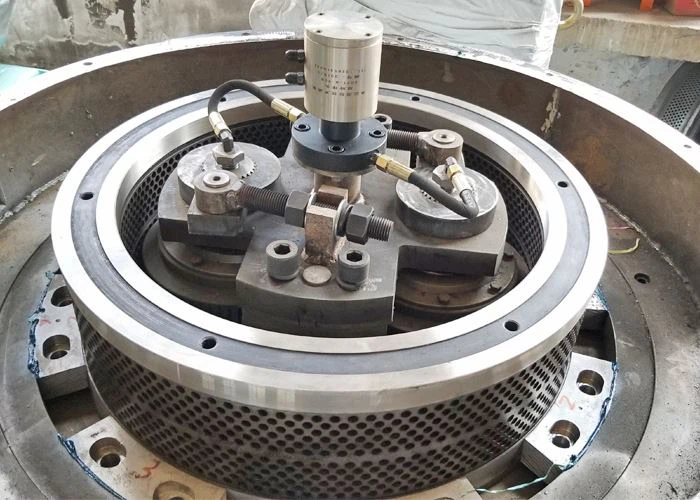
Vertical ring die pellet mill: The die lies horizontally (flat), with the die opening facing upward. Raw material falls straight down into the pelleting chamber by gravity. The die stays stationary while the rollers rotate inside it — a “fixed die, rotating rollers” design.
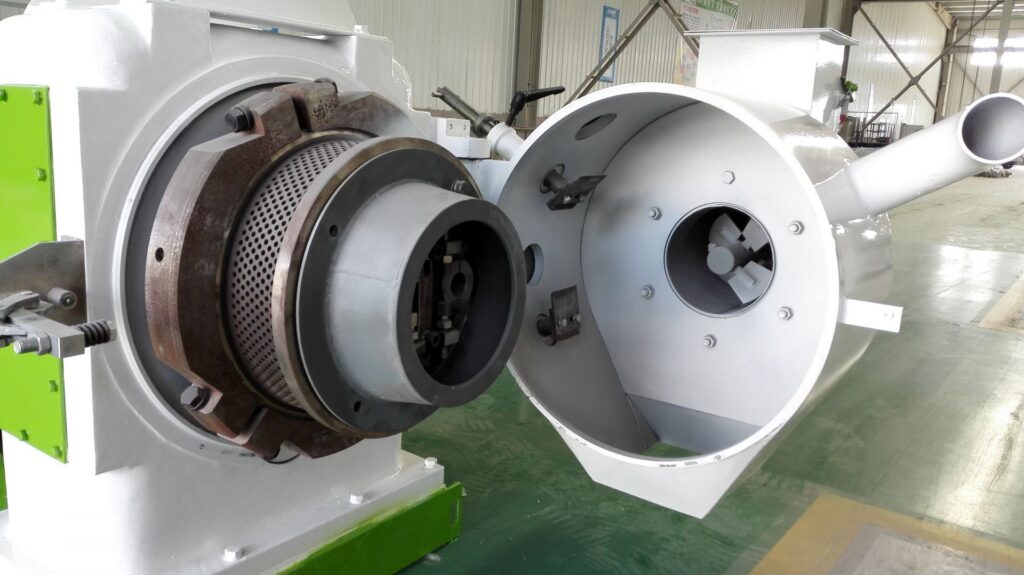
Horizontal ring die pellet mill: The die stands upright (vertical). Material is fed from the side through a curved chute into a pre-compression chamber. The die rotates at high speed while the rollers remain stationary — a “rotating die, fixed rollers” design.
Both are ring die pellet press machines. Both can make quality fuel pellets. The difference is in how the material moves, and that decides everything else.
2. Feeding: Gravity Beats a Curve Chute
Light biomass like dry sawdust has very low bulk density — it floats, bridges, and refuses to flow sideways. This is where the two biomass pellet machines separate.
In my field experience, the vertical mill’s top-feed design is simply more forgiving. Material drops straight in, a rotary distributor spreads it evenly across the die, and there is almost no blockage. The horizontal sawdust pellet machine uses a curved side-feed chute that works well with dense, free-flowing materials — but light fluffy feedstock piles up unevenly inside the pre-compression chamber, causing uneven roller wear and fluctuating output.
If you’re planning a wood pellet production line with mixed agricultural waste, this feeding difference alone often decides which pellet making machine fits.
3. Pellet Quality: The Secondary Crushing Problem
This is the point most buyers never hear about until it’s too late.
In a horizontal pellet press machine, the die rotates at 200+ RPM. Freshly formed pellets get flung around inside the chamber and collide with each other before discharge. This secondary crushing produces short, broken pellets and excess powder. In one side-by-side test we ran with oak sawdust for a pellet mill for sale evaluation, the horizontal machine produced about 8–12% fines; the vertical machine, where pellets exit directly downward at roughly 75 RPM, produced under 4% — a clear quality edge that directly affects your wood pellet plant profit margin.
4. Torque, Speed, and Difficult Raw Materials
Here is a simple analogy I use with customers of our industrial pellet mill series: high speed means low torque; low speed means high torque. A horizontal ring die pellet mill runs fast (200+ RPM) with lower pressing torque. A vertical one runs slow (~75 RPM) with heavy-duty, high-torque output.
For easy materials like softwood sawdust, both work fine. But for hardwood, rice husks, palm fiber, and coarse straw — a classic job for a rice husk pellet machine or straw pellet machine — you need sustained high pressure at low speed. The vertical design, typically paired with a three-stage heavy-duty gearbox, wins here.
5. Maintenance and Running Costs of a Biomass Pellet Mill
Let me speak from my maintenance notebooks rather than spec sheets:
Vertical biomass pellet mills usually come with automatic lubrication for rollers and main shaft, open chambers that dissipate heat well, and double-layer dies — when one layer wears, you flip or partially replace instead of scrapping the whole die.
Horizontal ring die pellet mills have mature, reliable gearbox designs — feed pellet mill operations have run them for decades. However, the sealed chamber traps heat, most models still need manual lubrication, and die replacement means full disassembly.
Honest summary: vertical = lower daily maintenance cost and less downtime for your pellet production line; horizontal = mature technology, but higher long-term servicing labor for biomass applications.
6. Capacity, Footprint, and Price
| Factor | Vertical Ring Die | Horizontal Ring Die |
|---|---|---|
| Typical capacity | 0.8–4 t/h per machine | Up to 8–20 t/h in large models |
| Best raw materials | Light, low-density, coarse-fiber biomass | Dense, uniform, free-flowing material, feed |
| Fines rate | Low (under ~5%) | Moderate (8–15% depending on material) |
| Heat dissipation | Excellent (open chamber) | Poorer (sealed chamber) |
| Lubrication | Usually automatic | Often manual |
| Maintenance cost | Lower | Higher for biomass use |
biomass use
7. So, Which Pellet Making Machine Is Better? My Decision Framework
Choose a vertical ring die pellet mill if:
- Your raw materials include sawdust, straw, rice husks, or peanut shells — the classic materials for a sawdust pellet machine or straw pellet machine
- You want lower fines, lower maintenance cost, and easier operation for your biomass pellet production line
- Your target capacity is roughly 0.8–4 tons per hour
Choose a horizontal ring die pellet mill if:
- You are producing feed pellets from grain-based materials with a feed pellet mill
- You run a very large continuous industrial pellet mill line (5+ t/h) with uniform feedstock
❓ Frequently Asked Questions
1. What is the main difference between vertical and horizontal ring die pellet mill designs?
The ring die position and pressing method. Vertical mills have a horizontal die with top gravity feeding; horizontal mills have a vertical rotating die with side feeding.
2. Which wood pellet machine is better for sawdust?
The vertical sawdust pellet machine is generally better. Gravity feeding handles light, low-density sawdust more smoothly and produces fewer broken pellets.
3. Can a horizontal ring die pellet mill make biomass fuel pellets?
Yes, but it was originally designed for feed pellet mill applications. For light biomass, it usually produces more fines and wears the die unevenly.
4. What is the ideal moisture content for a biomass pellet mill?
10–15% is ideal. Too wet causes blockage; too dry reduces pellet hardness and increases powder.
5. What raw material size does a pellet making machine require?
Generally 5 mm or smaller. A hammer mill is usually needed before pelletizing in a pellet production line.
6. What pellet diameters can a ring die pellet press produce?
Common sizes are 6, 8, 10, and 12 mm. The die hole diameter determines pellet size and can be customized.
7. Which biomass pellet mill has lower maintenance cost?
For biomass applications, the vertical design typically costs less to maintain, thanks to automatic lubrication and double-layer dies.
8. Is an industrial pellet mill suitable for 24/7 operation?
Yes. Quality machines are built with heavy-duty gearboxes, automatic lubrication, and cooling systems for continuous operation.
9. What auxiliary equipment do I need for a complete wood pellet production line?
A wood chipper or crusher, dryer, pellet making machine, pellet cooler, vibrating sieve, packing machine, and dust collection system.
10. How long does a ring die last in a pellet press machine?
Typically 800–1,500 hours or more with quality alloy steel and good maintenance; abrasive materials like rice husks shorten die life.
11. Can I test my raw material before buying a wood pellet machine?
Yes — and you should. Huaxin Machinery offers free trial pressing of customer raw materials at our factory.
12. How do I choose between ring die and flat die pellet mill for sale options?
Flat die mills suit small farms (under ~500 kg/h). For commercial production, a ring die pellet mill — vertical for biomass fuel — is the right choice.
Get a Free Wood Pellet Machine Consultation from Huaxin
Not sure which biomass pellet mill fits your raw material and budget? Don’t guess — test it. At Huaxin Machinery, we offer free raw material trial runs for every wood pellet machine at our factory, plus complete wood pellet production line design from crushing and drying to pelletizing, cooling, and packing.
Contact Huaxin today for a free customized solution and pellet mill price quotation. Tell us your raw material, target capacity, and budget — our engineers will reply within 24 hours.


